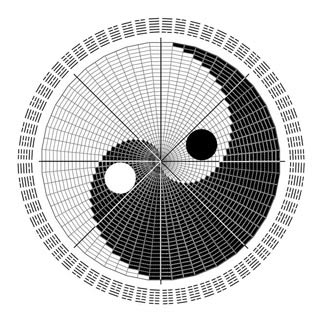
蒙
蒙:亨。匪我求童蒙,童蒙求我。初筮告,再三渎,渎则不告。利贞。
爻辞
初六:发蒙,利用刑人,用说桎梏,以往吝。
九二:包蒙吉;纳妇吉;子克家。
六三:勿用娶女;见金夫,不有躬,无攸利。
六四:困蒙,吝。
六五:童蒙,吉。
上九:击蒙;不利为寇,利御寇。
一、状态解析
蒙卦表示一个整体处于未明、待教、待启发、待建立判断能力的状态。
典型状态特征:
- 信息不完整,理解有限
- 需要引导、学习与辨别
- 系统处于启蒙、训练或认知形成阶段
需要注意:
- 缺乏判断容易误入歧途
- 过度依赖外部可能失去自主性
- 若反复混乱而不受教,问题会加重
1. State Analysis
Hexagram Meng represents a state of immaturity, limited understanding, and the need for guidance, learning, and discernment.
Typical characteristics:
- Incomplete information and limited understanding
- Need for guidance, education, and distinction
- The system is in a phase of initiation, training, or cognitive formation
Risks to note:
- Weak judgment may lead to wrong paths
- Excessive dependence may weaken autonomy
- Repeated confusion without learning may worsen the situation
二、未来预测
蒙卦的内在趋势:
无知未明 → 接受引导 → 形成判断 → 转入有序发展
常见方向:
- 受教得当 → 逐步开明
- 包容引导 → 形成能力与秩序
- 判断失误 → 转入困顿与混乱
- 拒绝修正 → 问题反复加深
2. Prediction
The inherent trend of Meng:
Unclarity → guided learning → formation of judgment → transition into ordered development
Common directions:
- Proper guidance → gradual clarity
- Inclusive teaching → development of capability and order
- Poor judgment → turning into confusion and difficulty
- Refusal to correct → repeated and deepening problems
三、因果干预(改变维度 → 改变状态)
核心原则:
改变一个维度(爻) → 整体状态转为新卦
3. Causal Intervention (Change a Dimension → Change the State)
Core principle:
Change one dimension (YAO) → the overall state transitions to a new hexagram
六个维度干预及对应结果
| 维度(爻) |
干预方向 |
结果状态(新卦) |
状态变化含义 |
| 初爻 |
启动基础认知、建立边界 |
损(41) |
从蒙昧转为减损杂乱、聚焦关键 |
| 二爻 |
加强包容与内在整合 |
剥(23) |
从启蒙不足转为去除表层、保留核心 |
| 三爻 |
修正关系判断、避免失当 |
蛊(18) |
从认知失误转为整治积弊 |
| 四爻 |
打开困局、重建方向 |
未济(64) |
从困蒙转为未完成但可继续推进 |
| 五爻 |
保持童蒙而受教 |
涣(59) |
从封闭认知转为疏解、流通与松动 |
| 上爻 |
防御混乱、建立正当约束 |
师(7) |
从击蒙转为有组织的治理与约束 |
3. Six Dimensions of Intervention and Outcomes
| Dimension (Line) |
Intervention |
Resulting Hexagram |
Meaning of Transition |
| Line 1 |
Activate basic awareness and boundaries |
Sun (41) |
From ignorance to reducing noise and focusing on essentials |
| Line 2 |
Strengthen inclusion and inner integration |
Bo (23) |
From weak enlightenment to stripping away surface confusion |
| Line 3 |
Correct relational judgment |
Gu (18) |
From mistaken perception to repairing accumulated disorder |
| Line 4 |
Open the deadlock and reset direction |
Wei Ji (64) |
From trapped ignorance to an unfinished but forward-moving state |
| Line 5 |
Remain teachable and receptive |
Huan (59) |
From closed cognition to dispersion, release, and flow |
| Line 6 |
Defend against disorder with proper structure |
Shi (7) |
From striking ignorance to organized discipline and governance |
参考 / References
Yi Dynamics AI / I Ching AI
https://www.researchmethods.org/iching.html
六爻体系与潜变量方法
https://www.researchmethods.org/6yaosystem.html
https://www.researchmethods.org/yangyinmethods.html