Advancing Prediction and Growing
with Data Science & AI (2010–2019)
📍 Refocusing on U.S. Projects and Enterprise Data & AI

In 2009, due to family needs and other factors, I stepped back from international travel and withdrew from overseas projects to concentrate on U.S.-based work. This transition also marked a deliberate shift in focus: I began dedicating my efforts to serving a smaller set of organizations more deeply, centering my work on enterprise services built around enterprise data and enterprise AI.
At the same time, I approached my work from a systems perspective—integrating enterprise data, organizational logic, and increasingly AI-driven methods into my models—while continuing to refine my predictive frameworks to improve both forecast accuracy and project success rates.
Some colleagues initially questioned this shift, but I explained that my expertise—spanning methods, processes, and technologies of data analysis—was always intended to improve the success of projects, particularly organization-wide initiatives. In fact, enhancing predictive accuracy and project success is a shared goal across civilizations’ methodological advances, often extending beyond the narrow boundaries of the modern scientific paradigm, and represents a deeply meaningful line of inquiry.
🧠 4E-Infused Modeling: Organizational Logic, Latents, and Enterprise AI

By incorporating organizational operations, latent variables—including faith and spiritual dimensions—and a 4E-based statistical-learning framework, I developed models that were not only more accurate but also faster to deploy. Over time, this approach evolved into an enterprise-oriented AI modeling and decision-support capability, grounded in real-world organizational complexity.
In 2007–2008, I had the opportunity to test several risk models for a major U.S. bank, achieving promising results that strengthened my confidence in focusing on enterprise applications. I subsequently resigned from my adjunct teaching roles to fully dedicate myself to non-academic, enterprise-focused work.
As data science and AI began to accelerate, my collaborations with institutions such as Stanford and USC increased rather than diminished. During this period, I also continued supervising selected doctoral research in areas related to spiritual capital.
🚀 Early Enterprise Engagements: Ingram Micro and the Rise of Data-Driven Transformation
My renewed focus happened to coincide with the rise of data science and machine learning, creating unexpected opportunities—and a platform to advocate for positive social impact in these fields.
My renewed focus coincided with the rapid rise of data science and machine learning, creating unexpected opportunities and allowing me to advocate for the positive societal impact of these technologies.
One of my first major engagements was with INGRAM MICRO, a Fortune 100 company undergoing transformation under the leadership of a former Disney CIO. I led a small team that, over three months, developed a strategy for using enterprise data and AI-driven analytics to guide business transformation. This work laid an important foundation for the company’s transition and marked an early milestone in my efforts to formalize enterprise data–driven and AI-enabled service models.
During this engagement, I also observed strong executive interest in Thomas H. Davenport’s Competing on Analytics. This led me to closely follow his work and eventually engage in collaboration and exchange with him.
🔍 Expanding Across Industries: Search, Fintech, and Enterprise AI Applications

After INGRAM MICRO, I worked with Shopzilla to improve search relevance through predictive modeling. It was there that I was first formally referred to as a “data scientist,” a title still uncommon at the time. This experience marked a shift from pure analytical work toward building enterprise AI-driven capabilities embedded within real business systems.
I then joined a fintech startup founded by former Google and Capital One executives as a machine learning specialist. There, I developed the company’s first production-grade credit-scoring model, significantly outperforming a previous consulting solution.
Subsequent projects included supporting a money transfer company’s data transformation, developing a customer 360 model for Toyota, and conducting program evaluation for USAID on compensation programs related to civilian casualties in Iraq. Across these diverse industries, the underlying focus remained consistent: leveraging enterprise data assets and deploying AI models to improve real-world decision-making and operational outcomes.
📈 Growing with the Field: The Emergence of Enterprise AI Practice

These projects provided invaluable opportunities to validate models using real-world data and to grow alongside the emerging field of data science. When I was first hired as a data scientist in 2010, the role itself was still largely unfamiliar.
At the same time, Thomas H. Davenport’s work was helping define and popularize the field. His 2012 Harvard Business Review article describing data science as the “sexiest job” played a key role in shaping the profession.

Following a talk I gave at Harvard, Davenport and I reflected on our shared background as sociologists—he from Harvard, and I from Stanford—and noted how uncommon it was for sociologists to become deeply embedded in data science and AI practice.
🌐 RMDS Community and Scaling Enterprise Data & AI (2013–2019)

In 2009, with the support of colleagues and friends, I founded the Research Methods and Data Science (RMDS) community. Without formal promotion, it grew into a globally recognized network with tens of thousands of members.
The Southern California chapter collaborated with organizations such as the City of Los Angeles, Disney, and USC to host events focused on smart cities, governance, education, and data-driven systems—contributing meaningfully to the regional development of data science and enterprise AI applications.


After joining IBM in 2013 as a big data scientist, both my professional work and the RMDS community expanded rapidly, creating new opportunities for collaboration, research, and thought leadership in enterprise data and AI.
📚 Capital, Values, and AI for Social Impact

In 2014, Thomas Piketty’s Capital in the Twenty-First Century sparked global discussions that intersected with my earlier work on the 4CAPITAL framework. During a period working in London in 2016, I became more deeply engaged in conversations about how data science and AI could be applied to generate positive societal outcomes.

Through collaborations with cities such as Los Angeles and Chicago, as well as continued advocacy, my work became increasingly associated with the principle that enterprise data and AI should ultimately serve broader public benefit.
That same year, I traveled to China to deliver enterprise data and machine learning training for IBM, visited my hometown in Jiangxi, and continued my exploration of faith-related dimensions through a visit to Salt Lake City.
🛠️ IBM Projects: Enterprise AI Platforms at Scale

At IBM, I contributed to a wide range of enterprise data and AI initiatives, including integrating R, SPSS, and Watson; building machine learning workflow systems on Apache Spark; developing weather-data business applications; advancing AI training and certification programs; managing risk-prediction pipelines; and enabling IoT data intelligence.


We deployed enterprise-grade AI platforms, including Watson Studio and related technologies, across major organizations such as Saudi Aramco, Farmers Insurance, and NASA JPL, while also collaborating with leading academic institutions including Harvard, the University of California, and Caltech.
I also supported enterprise AI development efforts with banks and companies across Europe. One notable collaboration with NASA JPL on hurricane-density prediction using machine learning received the American Meteorological Society’s Banner I. Miller Award, among other recognitions.
Through these efforts, my work increasingly took the form of scalable, systematized enterprise data and AI service frameworks.
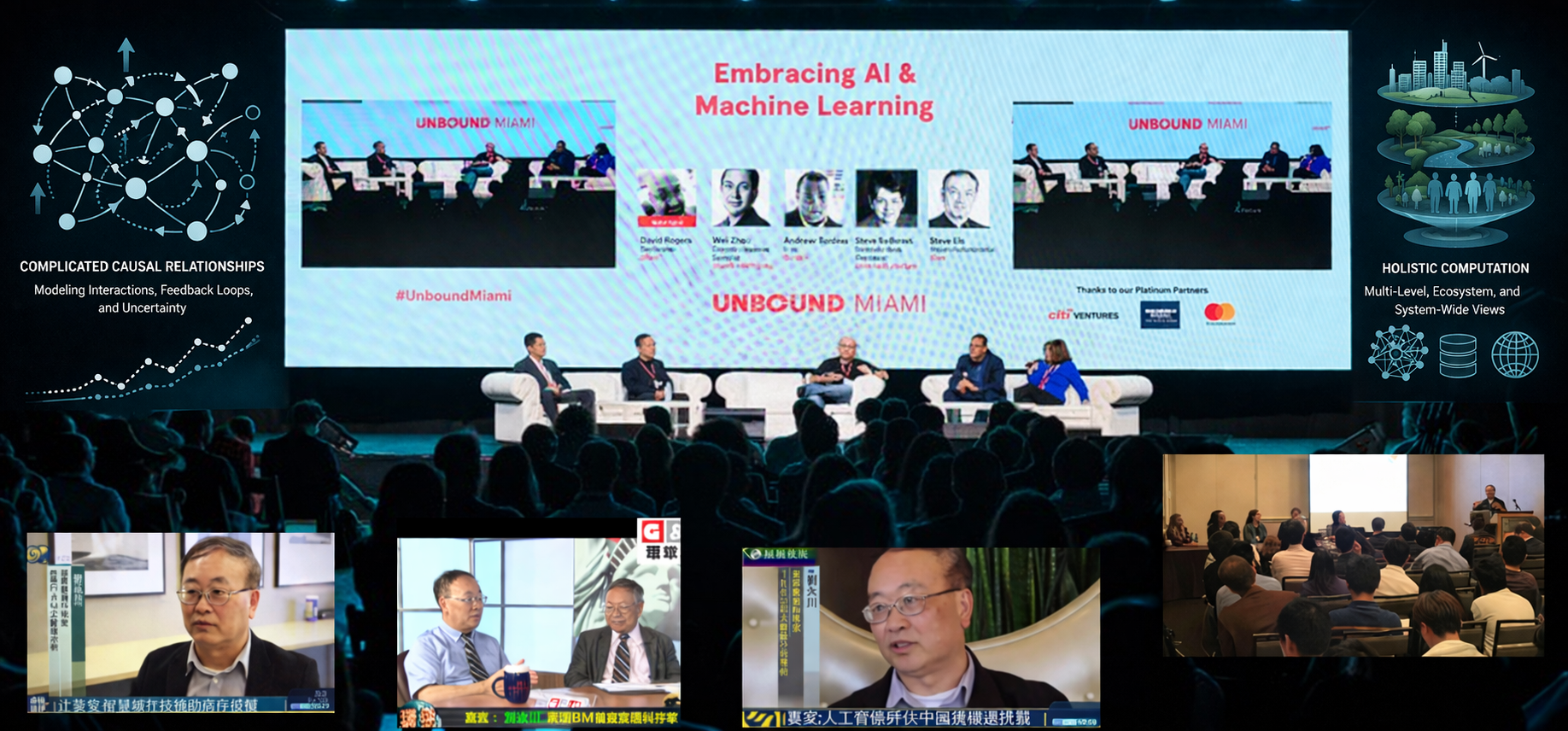
🌱 Ecosystem Approach and Toward Holistic Computation


During my time at IBM, I held roles such as Chief Data Scientist, Distinguished Data Scientist, and Thought Leader, and was invited to deliver numerous talks and keynote presentations.
I proposed the Ecosystem Approach, which integrates expert communities with structured processes to improve project success rates, and presented it at IBM’s annual conferences from 2016 to 2019. A key component—reinforcement learning with expert feedback—gained broad adoption.

Beginning in November 2019, I served as an advisor to the Harvard Data Science Review and as Series Editor for Taylor & Francis’s Impactful Data Science.
Building on earlier work in incubation systems, 4CAPITAL, and data science ecosystems, I developed new frameworks that embed 4E-based reinforcement learning with expert feedback into process optimization, alongside a four-dimensional model of knowledge spanning material, intellectual, social, and spiritual domains.
These efforts ultimately converged into a broader framework I call Holistic Computation—an approach oriented toward enterprise data and AI-driven decision systems, integrating technical, organizational, and human dimensions. Looking back, many of the themes that had shaped earlier stages of my journey—community, knowledge sharing, human values, and technology-enabled collaboration—reappeared in new forms within the emerging field of data science.
References: