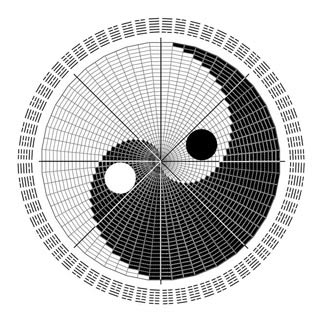
易经方法概论 4E
|
六爻体系的完备性 E1 |
各爻取值的潜变量方法 E2
|
易经的解析框架 E4
Bridging Ancient Wisdom and Modern
Intelligence:
Dr. Alex Liu's 4E Framework
and Its Implications for Artificial General
Intelligence
Introduction
In the dynamic field of artificial
intelligence, especially in the ambitious
pursuit of Artificial General Intelligence
(AGI), innovative methodologies have
emerged, blending historical wisdom with
cutting-edge technology. A prime example is
Dr. Alex Liu's 4E framework—encompassing
Equation, Estimation, Evaluation, and
Explanation—specifically tailored for
machine learning. This framework not only
embodies an advanced approach to data
analysis and algorithmic development but
also creates a bridge between the
time-honored wisdom of the I Ching and the
evolving sphere of AGI. It heralds a new era
of wisdom-guided intelligence production,
mirroring the significance of Leibniz’s
invention of binary mathematics, which drew
inspiration from the I Ching’s binary
representation of reality through Yin and
Yang.
Dr. Alex Liu's 4E Framework
Dr. Liu's 4E framework presents a
systematic, methodical approach to machine
learning. It starts with 'Equation',
involving the selection of suitable models
and algorithms. 'Estimation' follows, where
these algorithms are used to generate model
coefficients from data processing.
'Evaluation' involves a rigorous assessment
of these models using test datasets to
determine their accuracy and practical
applicability. The final phase, 'Explanation
or Execution', interprets model coefficients
in specific application scenarios, using
models for diverse content generation, a key
aspect of generative AI, thereby enhancing
the transparency and interpretability of
models—an essential component in AGI's
evolution.
I Ching-Guided Machine Learning
Integrating the I Ching into this framework
marks a substantial shift in machine
learning methodologies. Applying the I
Ching's 64 hexagrams (GUA) as potential
models, akin to using 4Capital’s expanded
6-dimensional modeling to enhance the 6 YAO
structure, and enriching the 'Explanation'
phase with its historically tested wisdom,
could be revolutionary. The I Ching's
principles, which emphasize the balance of
opposites and universal interconnectedness,
can influence the development of algorithms
for model coefficient estimation. This
enhances the 'Estimation' and 'Evaluation'
phases with deep philosophical insights,
especially from ecosystem and human
perspectives. This integration promises
predictive models that blend computational
efficiency with the I Ching’s heuristic
insights.
Implications for Artificial General
Intelligence
The fusion of the I Ching's timeless wisdom
with AGI, via Dr. Liu's 4E framework, could
give rise to a distinct form of
intelligence, or more human-centered
intelligence. This emerging intelligence,
technologically sophisticated, is likely to
be rich in philosophical depth and ethical
sensitivity. This approach seeks to align
AGI development with humanistic values
represented by the I Ching and other wisdom
traditions, addressing current ethical
challenges in AI advancement.
Conclusion
Integrating the I Ching's holistic and
balanced perspectives could profoundly
influence AGI development, aligning it more
closely with human needs and the natural
environment. Dr. Liu's 4E framework forges a
path where ancient wisdom not only informs
but also amplifies modern technological
advancements. This union of historical and
contemporary intellect is poised to lead to
an AGI that is not only cognitively superior
but also philosophically insightful,
ensuring a future for AI that is as rich in
wisdom as it is in intelligence.
按此阅读该文中文版